30 November 2010

Mind Vs. Reality

imageI my mind when I think about how I want to so easily impose my game.  Be able to flow from one move to the next and essentially have my partner have no idea on how to keep up.  I can imagine myself effortless chaining armbars into sweeps and making it look easy.  Move like a butterfly, sting like a bee.

The reality is starkly different.

I’m often jerky and slow.  I don’t attack that well.  I’m often stuck on my back.  I get lazy and start to rest when I should be moving.  I can’t get arm bars at all, I’m always out of position.  I can’t get chokes,  it feels like they are always defending and so much stronger.  This can come from just having one or two bad rolls.

It’s funny, if I can’t impose any of my game plan on someone it can be quite deflating.  Admittedly I’m not going flat out any more, but still I feel that I should be able to flow and impose a game plan against people going hard.

I feel I have more technical knowledge than most.   This comes from knowing all the finer points that most people forget, and I see that they have forgotten in drilling.  However I’m struggling translating technical knowledge into ground advantage.

I feel my timing is off.  Windows of opportunity are passing me by and I’m just powerless to stop it.  This I imagine frustrates a lot of BJJ practitioners.  The problem is the other guy (or girl).  They are learning too, and I imagine in their own mind would also see themselves as rolling the way I envision I want to roll.

I want to be a butterfly,  yet I’m just a slimy slug atm.  I know what I want to do, but it’s so far away right now.  I guess that’s why I’m liking the going back to basics.  Re-assessing everything I know about BJJ.

Hopefully one day I’ll stop being such a slug.  For now I have to learn how to quicken my timing to take advantages of tactical errors.

Dan

22 November 2010

70% Effort

image I’ve started asking my partners in training to go at 70%.  It seems every time I roll with people at my gym they want to go at 110% like it’s a competition.  A few things always happen.

  1. There is lots of stalling and getting ‘stuck’.
  2. You get to practise very few positions as everything is a grind.
  3. Frustration usually occurs
  4. Rapid tiredness

My theory is this:  If I’m able to roll for 40 minutes straight instead of 6 minutes then I’m going to be practising a ton more positions and rolls. I can refine my timing!

At my gym it seems people prefer rolling to drills, and to me this seems like a good compromise if I have to train with those people. So I’m asking my partners not to go at 100%,  purposely have more give and take in the rolls.  My first roll went for 20 minutes straight and we both had fun! We both got a ton of positions, submission attempts and escapes – what more could you ask for in a roll.

It did have some side effects, like a lot more laughter and fun being had. The nice thing was it still achieved my goal of getting more repetition.  I got to get to the same positions far more often and could experiment far more rapidly. I could start to see two moves ahead, and even guide my partner into positions I wanted by opening up something.  My partner too was relishing the non-competitiveness of this and attempting rolling arm-bars and other such things that you rarely get to try.

So many other sports rarely train at 100%,  I wonder why Jui-Jitsu guys feel the need to always train like it’s a competition?  To me this seems unhealthy and counter-productive to actually progressing your skills.  You don’t see it in other sports,  it’s not like Football players play competitive football every training session,  or golfers play rounds of golf.

Food for thought.

Dan

03 November 2010

Slow and Steady

Training has been going slow and steady for me as of late.  I’m just getting back into my old gym and trying to step up in a few areas.   One thing I didn’t want this blog to be is a, oh I trained this tonight.  I wanted it to be more of a reflective blog about the basics of BJJ.  So part of that has seen me go back to the beginner class in an assistant instructor rule.  Essentially being someone else’s test dummy.

The great thing about this is,  I get to practise all the fundamental moves.  I have limitations,  flexibility being the main one.  I’m going to start sacrificing strength for more flexibility.  It'll take time, but I think in the long term the transition is the correct one to make.

As for training, I’m taking things slow and steady.  I need my rest days, and I am definitely looking forward to improving my teaching style.  I’m of the belief that you can be great at something, but you might not be the best teacher.  This fits in with my long term goals. 

  1. Master the basics
  2. Make BJJ a part of my life
  3. Develop strong connections with people from all circles of life.

I guess technique area’s I’m looking to improve are guard sweeps and passing to mount.

26 October 2010

Flexibility and Arm Bars

I’ve struggled with arm bars.  You see I’m not the most flexible person in the world,  I can’t even touch my toes if my legs are straight,  both my hamstrings and back are really stiff.  So often I find myself in very uncomfortable positions well before most people do, especially when it comes to stacking. 
The thing with the stack for say Arm bar from guard is that I feel way to much pressure before they have over committed to the stack.  It frustrates me that such a large part of the BJJ is difficult for me because I don’t even have average flexibility,  I’m within the bottom 5% I’d say. 

Anyway, I’ve already vowed to improve my flexibility.  I wish I had a time machine as I’d go back to when I was 12 years old and tell myself  to stretch everyday. I know it will take awhile but I’m hoping I can at least touch my toes comfortably in 6 months time.

As for the arm bar stacking I’ve learn some good pointers so far.  Don’t cross your legs as you lose downward force, raise your hips and lastly rotate underneath them, creating a fulcrum point with my body when they over-commit the stack.   I don’t consider arm bars part of my game, I do need them though to generate threat from my true goal,  the choke.  Still two aspects let me down,  flexibility and timing.  For me,  both of which will take time to solve.

Dan

22 October 2010

Training with non-likeminded Training Partners

One thing I’m struggling with is to get some consistent training in atm.  I find my motivation for training really does depend upon the training partners I have available.  I find I just don’t connect too well with people from my school – they have a different outlook on life.  Which is fine,  it’s just hard to find someone who is a details person, and likes drilling over those finer details.

I find most people (not all) from my experience, either look down on other martial arts or those concepts of respect, courtesy, professionalism.  Instead, they often are bealching, swearing bogans (aussie term) which frustrates me.  So I’m going to work out how to thrive in that environment, and hopefully I can find one or two others that are like me.

For now, cause they like to wrestle I will just pick the exact same technique everytime I go out there…try to get to the same position, try to work back to that position.  I have my basic game play, so I’m hoping I can refine that down to it’s pure elements.  I feel comfortable passing peoples guard,  I don’t feel comfortable obtaining mount.  So I might try a catch and release style of training when doing live wrestling. Get mount, hold, get off mount…try to get mount again.

23 September 2010

Half Guard to Cross Collar Choke Analysis

I decided to have a break this week from training.  However after my last little successful module on closed guard I thought I’d start my research around my next major area I want to improve.   Just to be clear,  I’m not a youtube warrior and I’m not after anything fancy…in fact I’ll only look for really small simple stuff however I want the little details that make the difference.

So I’ve been doing some research on transitions that end up in the mount, and hopefully setup my favourite submission the Cross Collar Choke.  I’m naturally a slow moving guy on the ground and not that flexible.  So I’m after nice reliable and repeatable ways to get the mount.

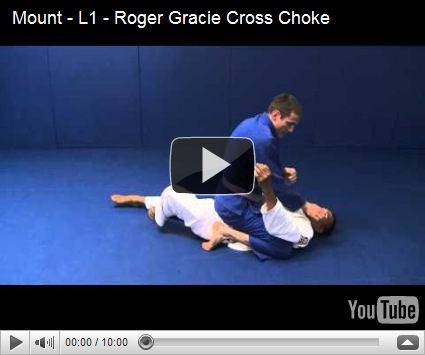
I came across an outstanding breakdown video on Roger Gracie’s Cross Collar Choke that involves an analysis on how he transitions from Half Guard to Mount.  Fundamentally what I like about Roger Gracie (and this example) is how he just sticks to basics, and he has them down in such a minute detail that they really work for him.

I’ll give a breakdown from what the video talks about:

  1. Start in Half Guard, preferably on your opponents left side (as this will eventually set up your more dominate right handed grip for the choke)
  2. Close the space (which is a problem in itself)
  3. Get your right hand under their head reaching as deep as possible to grab under their right armpit with your right hand.
  4. The result should be your bicep is cutting across their Artery and you generate tremendous pressure via a pull push motion.
  5. Unravel their gi with your left hand and pass it across to your right hand
  6. tighten the grip by grabbing the lapel deep under their arm pit and lean over them more.  Don’t push your shoulder into their face, instead go for a deeper grip.
  7. Try to get your head inside their elbow (arm triangle setup) or just put your head all the way to the ground beside their right arm
  8. Turn your hips Anti-Clockwise a bit and straighten your right leg
  9. Your left leg should be bent coming with the knee coming up close to their butt
  10. Use your free left hand to push their right knee down so you can pass your left knee over the top of it
  11. When you finally free your foot bring your right knee high up under their armpit so you can secure a high mount immediately.  Do not lift your head off the ground
  12. Release the lapel with your right arm
  13. Loosen the lapel with your left hand while keep your head low
  14. Bring your right arm back around their head and secure the collar grip
  15. Use your left hand to help adjust the lapel to get a deeper grip
  16. Crunch down hard with your right elbow onto their chest, raising their head.
  17. Loosen the gi with your right hand
  18. Bring your left hand around and under their raised head keeping your left elbow inline with their spine
  19. secure the second grip and bring over to complete the choke
  20. Put your head on the mat above their head to finish it

I really like that this set up creates it’s pressure through a pull push action.  Like knee ride the end result is more than just your weight being applied.  I like that this pass and set up takes away the opponents ability to create space,  the only time is at the start after that you have no space to work with.  Lastly I like that it gets a dominate high mount immediately, and the pressure doesn’t end until you’ve achieved that. 

It should be noted I’ve seen Roger Gracie use his right foot on their hip in high mount to defend the upa.  So I think getting the high mount at least with the right leg is also critical to the success of this move.


Dan

16 September 2010

The Process of Rebuilding my Guard

tick Sometimes to move forward you have to tear down what you already have and rebuild.  Fix the foundation so to speak.  In my case I can compare my old guard game like a skyscraper made out of match sticks where it was so fragile that it would come crashing down at the slightest hint of a breeze.  Sure, it had a lot of facets to it, but it wasn’t sturdy or reliable. I’ve gone back and looked at a lot of my techniques in Guard, thrown out most and slowly tried to develop a plan for guard that involves good basic technique without the bells and whistles.  It’s now a modest house, but at least I can live in it.

My requirements were:

  • Closed Guard only, no open guard, half guard, De La Riva, X-Guard, Butterfly Guard etc
  • Gi and No Gi Grips (while using a Gi)
  • Exploiting Resistance with Timing, no strength battles.
  • Fundamental Sweeps (Scissor, Hook, Sitting Roll Over and Scoop Sweeps)
  • Good Defence against passes (under, around, through and over) from both closed guard and a compromised unlocked guard.

I have to say, Point 3 is the hardest but what I consider the most important for everything Jui-Jitsu.  I rediscovered a lot of the essential concepts again going through this process.  My journey roughly involved the follow training area’s over many training sessions.

  1. Getting Grips
  2. Breaking Posture
  3. Effective use of timing  to exploit the grip fight, posture battle, strength, stacks etc
  4. Timing Submission attacks
  5. Through passes, and counters to these
  6. Compromised broken guard and counters to passes around or over
  7. Timing sweep attacks
  8. Putting it all together

I’m really glossing over details here, but honestly I found having a methodical process really helped.  The most important question I now ask myself is, what is the path of least resistance to get what I ultimately want.  Some things I rediscovered to a deeper personal understanding through this, and I guess to some degree I’ve taken ownership of these concepts.  They include:

  1. Frames, creating and maintaining space
  2. Timing, real jiu-jitsu is in the transitions using your opponent’s movement against them.
  3. Resistance Drilling to improve timing,  seriously I should have done this years ago.
  4. Grips, you don’t have control without them.
  5. Don’t Fight muscle with muscle – it’s so easy to do subconsciously.
  6. Always Attack when you have guard.
  7. Move those hips, get to the side.

Anyway, from where my Closed Guard was technique wise, I now feel it’s far improved. I don’t rely on one trick ponies anymore. It’s consistent and I feel that sticking to basic techniques has actually made me a lot more creative and dangerous.  So overall for the time being I’ve accomplished my mission with Closed Guard.

I will start focusing on Side Control to Mount for the next month or so.  Really my plan is sweep, pass, mount, choke.  I’m going to explore every avenue in achieving the goal of pass. For revision in warm ups I will incorporate some of the cooperative resistance drills for Closed Guard to keep my timing sharp.

Dan